Rovagug
The Rough Beast, The Destroyer, Enemy of the Gods, The Great Destroyer, The Unmaker, The Worldbreaker
PFS Legal
Pantheon
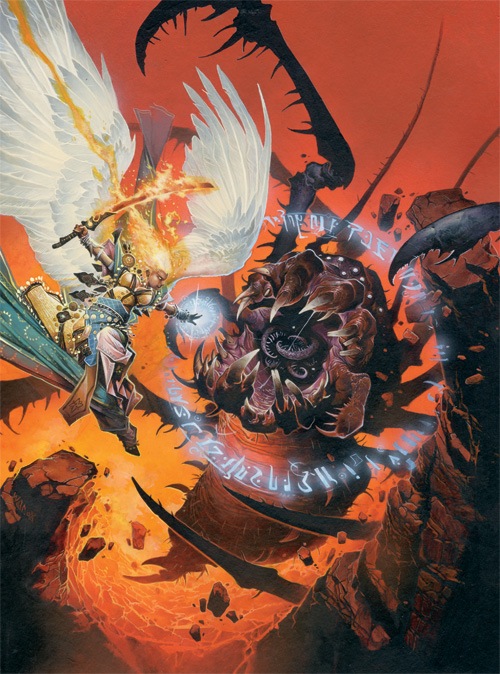
Imprisoned since the Age of Creation, the god Rovagug (pronounced ROH-vah-gug) seeks only to destroy creation and the other gods. Believed to be imprisoned in a state of torpor somewhere deep within Golarion, his increasingly restless stirrings are taken by many to be the cause of volcanic activity and earthquakes.
- Alignment
-
CE
Chaotic EvilA chaotic evil character is driven entirely by her own anger and needs. She is thoughtless in her actions and acts on whims, regardless of the suffering it causes others.
In many ways, a chaotic evil character is pinned down by her inherent nature to be unpredictable. She is like a spreading fire, a coming storm, an untested sword blade. An extreme chaotic evil character tends to find similarly minded individuals to be with—not out of any need for company, but because there is a familiarity in this chaos, and she relishes the opportunity to be true to her nature with others who share that delight. - Nationality
- Monster
- Areas of Concern
- Destruction, disaster, wrath
- Favored Weapon
- Greataxe
- Symbol
- Fanged spider
- Sacred Animals
- Scorpion
- Sacred Colors
- Brown, red
- Worshipers
- Orcs, kholo, savage tribes
- Worshipper Alignments
-
CN
Chaotic NeutralA chaotic neutral character values his own freedom and ability to make choices. He avoids authority and does not fear standing out or appearing different. In extreme cases, he may embrace a lifestyle entirely suited to himself— living in a cave near a city, becoming an artist, or otherwise challenging traditions. He never accepts anything at face value and makes up his own mind rather than blindly accepting what others tell him to do or think., NENeutral EvilMotivated by his own needs and wants, a neutral evil character is without conscience, acting only for self-gratification. He might surround himself with the trappings of cults and evil, but does so purely because it brings him closer to sin and wickedness. While a lawful evil person is inclined to bargain and a chaotic evil one to lash out, a neutral evil person is inclined only to look out for himself. In many ways, he epitomizes evil, since he has no clear loyalty to anything except absolute self-interest., CE
An extremist neutral evil character tends to be a loner, since he has either betrayed or slain those who came close to knowing him.Chaotic EvilA chaotic evil character is driven entirely by her own anger and needs. She is thoughtless in her actions and acts on whims, regardless of the suffering it causes others.
In many ways, a chaotic evil character is pinned down by her inherent nature to be unpredictable. She is like a spreading fire, a coming storm, an untested sword blade. An extreme chaotic evil character tends to find similarly minded individuals to be with—not out of any need for company, but because there is a familiarity in this chaos, and she relishes the opportunity to be true to her nature with others who share that delight. - Realms
- Dead Vault
- Centers of Worship
- Belkzen, Darklands, Katapesh, Realm of the Mammoth Lords, Osirion, Qadira
Edicts
Destroy all things, free Rovagug from his prison
Anathema
Create something new, let material ties restrain you, torture a victim or otherwise delay its destruction
Obedience
Smash an assortment of items worth at least 10 gp, preferably something fragile, aesthetically beautiful, or with significance to a good-aligned deity (particularly Sarenrae). The more devout servants of Rovagug seek out and hoard particularly expensive, artistic, or rare items, such as fine bottles of wine or delicate curios, to smash during their obedience. Roll in the shards of the destroyed items, howling and shouting praises and curses invoking the Rough Beast, until the shards draw blood and your lungs ache. Gain a +4 bonus on attack and damage rolls against objects.Divine Gift
Divine Gifts
The gods do not need to wait for mortals to call upon them for aid to grant boons. At times, when a character performs a particularly devout act or completes a legendary crusade, that character’s deity may choose to reward her with a divine gift.
The timing and frequency in which divine gifts are granted is left strictly to the discretion of the GM. They can be given to a particularly devout worshiper in a time of need. They might be granted upon the completion of a significant quest that furthers the faith. Or they might be rewards given in return for a significant sacrifice made in a deity’s name or dedication shown to the deity. A divine gift can be granted to any creature, even to a follower of a different deity or to a creature who does not worship the divine at all. The only restriction is that a creature must be sapient in order to receive a divine gift, for a creature always has the option to refuse the gift if it so wishes—the freedom to accept or reject such a gift is part of the nature of this boon. However, at the GM’s discretion, rejecting a divine gift from a deity you worship (or accepting a divine gift from a rival deity) may have repercussions.
Divine gifts can be of any power level, but the example gifts presented in the following section focusing upon the core pantheon are all on par with effects that could be granted by a miracle spell—feel free to adjust this power level as you prefer for your home campaign. At your discretion, you can allow divine spellcasters to duplicate the effects of a divine gift (as appropriate for their deity) by casting miracle themselves.
Source: Planar Adventures
The recipient gains the ability to bring destruction by casting one of the following spells as a spell-like ability (CL 20th): implosion, meteor swarm, storm of vengeance, or tsunami.Antipaladin Code
The antipaladins of Rovagug seek their master’s Great Awakening, and bend all their efforts toward the eventual decay of the prison that holds their god. Their code is simple, brutal, and direct, and its tenets include the following adages.- All things must be destroyed, but the tools of destruction will be destroyed last.
- The beautiful die first. Their loss wreaks havoc in the hearts of those who love.
- All is vanity before the tide of destruction.
- The world is a lie. The only truth is oblivion, born of storm and horror.
- Torture is needless delay. I give the gift of a quick death.
- I will die standing.
Boons
Deific Obedience
Required feat: Deific Obedience
Evangelist
Source: Inner Sea Gods
PFS Legal
Agent of the Beast (Sp)
Destructive Spell (Su)
The Destroyer's Gifts (Su)
Exalted
Source: Inner Sea Gods
PFS Legal
Destructive Force (Sp)
Bestow Destructive Smite (Su)
Apocalyptic Ally (Sp)
Sentinel
Source: Inner Sea Gods
PFS Legal
Inexorable Death (Sp)
Wicked Claws (Ex)
Disintegrating Blow (Sp)
Domains
Chaos, Destruction, Evil, War, Weather
Subdomains
Blood, Cannibalism, Catastrophe, Corruption, Demodand, Demon, Hatred, Lightning, Protean, Rage, Storms
Spells Requiring Worship
Brittle Portal, Face of the Devourer, Mythic Spawn Calling, Rovagug's Fury, Spawn Calling
Unique Summon Rules
Source: Pathfinder #23: The Impossible Eye
-
Summon Monster 3
:
Choker
—CE
Chaotic EvilA chaotic evil character is driven entirely by her own anger and needs. She is thoughtless in her actions and acts on whims, regardless of the suffering it causes others.(extraplanar)
In many ways, a chaotic evil character is pinned down by her inherent nature to be unpredictable. She is like a spreading fire, a coming storm, an untested sword blade. An extreme chaotic evil character tends to find similarly minded individuals to be with—not out of any need for company, but because there is a familiarity in this chaos, and she relishes the opportunity to be true to her nature with others who share that delight. -
Summon Monster 5
:
Fiendish Grick
—NE
Neutral EvilMotivated by his own needs and wants, a neutral evil character is without conscience, acting only for self-gratification. He might surround himself with the trappings of cults and evil, but does so purely because it brings him closer to sin and wickedness. While a lawful evil person is inclined to bargain and a chaotic evil one to lash out, a neutral evil person is inclined only to look out for himself. In many ways, he epitomizes evil, since he has no clear loyalty to anything except absolute self-interest.
An extremist neutral evil character tends to be a loner, since he has either betrayed or slain those who came close to knowing him. -
Summon Monster 5
:
Gibbering Mouther
—CE
Chaotic EvilA chaotic evil character is driven entirely by her own anger and needs. She is thoughtless in her actions and acts on whims, regardless of the suffering it causes others.(extraplanar)
In many ways, a chaotic evil character is pinned down by her inherent nature to be unpredictable. She is like a spreading fire, a coming storm, an untested sword blade. An extreme chaotic evil character tends to find similarly minded individuals to be with—not out of any need for company, but because there is a familiarity in this chaos, and she relishes the opportunity to be true to her nature with others who share that delight. -
Summon Monster 7
:
Emkrah
—CE
Chaotic EvilA chaotic evil character is driven entirely by her own anger and needs. She is thoughtless in her actions and acts on whims, regardless of the suffering it causes others.
In many ways, a chaotic evil character is pinned down by her inherent nature to be unpredictable. She is like a spreading fire, a coming storm, an untested sword blade. An extreme chaotic evil character tends to find similarly minded individuals to be with—not out of any need for company, but because there is a familiarity in this chaos, and she relishes the opportunity to be true to her nature with others who share that delight.
Unique Spell Rules
Source: Inner Sea Gods
PFS Legal
Antipaladin, Cleric, Druid, Inquisitor, Warpriest — Baleful Polymorph : can be prepared as a 4th-level spell