Sarenrae
The Dawnflower, The Cleansing Light, The Everlight, The Healing Light, The Healing Flame, Sister Cinder, Grandmother Grace
PFS Legal
Pantheons
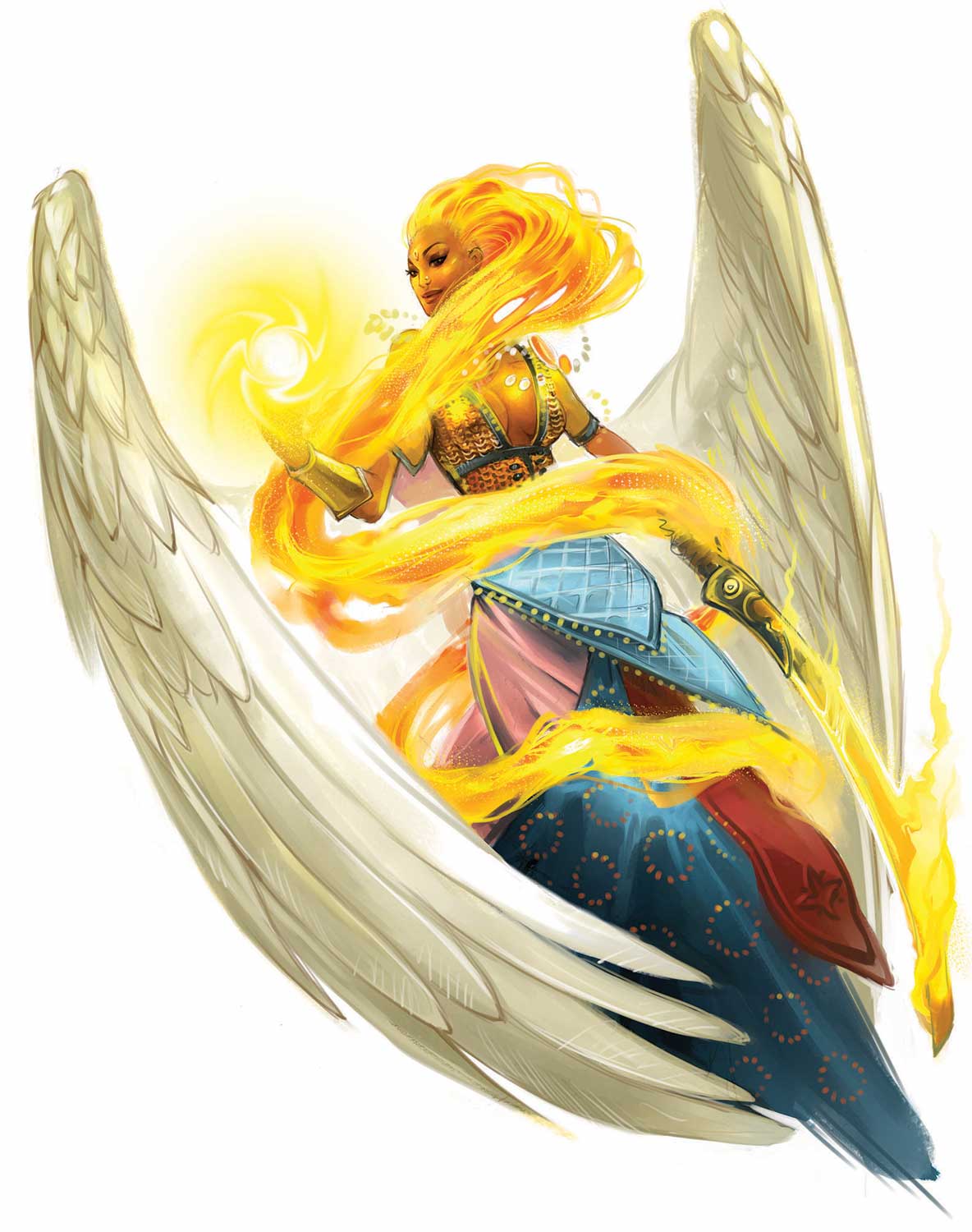
Known to her faithful as the Dawnflower, the Healing Flame, and the Everlight, Sarenrae (pronounced SAER-en-ray) is a goddess who teaches temperance and patience in all things. Compassion and peace are her greatest virtues, and if enemies of the faith can be redeemed, they should be.
- Alignment
-
NG
Neutral GoodA neutral good character is good, but not shackled by order. He sees good where he can, but knows evil can exist even in the most ordered place.
A neutral good character does anything he can, and works with anyone he can, for the greater good. Such a character is devoted to being good, and works in any way he can to achieve it. He may forgive an evil person if he thinks that person has reformed, and he believes that in everyone there is a little bit of good. - Nationality
- Keleshite
- Areas of Concern
- Healing, honesty, redemption, the sun
- Favored Weapon
- Scimitar
- Symbol
- Angelic ankh
- Sacred Animals
- Dove
- Sacred Colors
- Blue, gold
- Worshipers
- Healers, farmers, redeemed evil-doers
- Worshipper Alignments
-
LG
Lawful GoodA lawful good character believes in honor. A code or faith that she has unshakable belief in likely guides her. She would rather die than betray that faith, and the most extreme followers of this alignment are willing (sometimes even happy) to become martyrs., NG
A lawful good character at the extreme end of the lawful-chaotic spectrum can seem pitiless. She may become obsessive about delivering justice, thinking nothing of dedicating herself to chasing a wicked dragon across the world or pursuing a devil into Hell. She can come across as a taskmaster, bent upon her aims without swerving, and may see others who are less committed as weak. Though she may seem austere, even harsh, she is always consistent, working from her doctrine or faith. Hers is a world of order, and she obeys superiors and finds it almost impossible to believe there’s any bad in them. She may be more easily duped by such imposters, but in the end she will see justice is done—by her own hand if necessary.Neutral GoodA neutral good character is good, but not shackled by order. He sees good where he can, but knows evil can exist even in the most ordered place., CG
A neutral good character does anything he can, and works with anyone he can, for the greater good. Such a character is devoted to being good, and works in any way he can to achieve it. He may forgive an evil person if he thinks that person has reformed, and he believes that in everyone there is a little bit of good.Chaotic GoodA chaotic good character cherishes freedom and the right to make her own way. She might have her own ethics and philosophy, but is not rigidly held by them. She may try to do good each day, perhaps being kind to a stranger or giving money to those less fortunate, but does so purely out of joy. Such a character makes up her own mind up about what is good and right based upon truth and facts, but does not fool herself that evil acts are good. Her goodness is benevolent—perhaps occasionally blind, but always well meant., N
A chaotic good character can seem unpredictable, giving alms to an unfortunate outside a church but refusing to make a donation within. She trusts her instincts and could put more stock in the words of a beggar with kind eyes than the teachings of a harsh-looking bishop. She might rob from the rich and give to the poor, or spend lavishly for her own joy and that of her friends. In extreme cases, a chaotic good character may seem reckless in her benevolence.NeutralA neutral character is unusual in that she may have one of two distinct philosophies: she may be a person who is neutral because of distrust or apathy toward others, or one who wishes to have a truly neutral stance in the world and rejects extremism.
A neutral character could seem selfish or disinterested. She might be driven primarily by an acceptance of fate, and the most extreme followers of this alignment become hermits, hiding from the zealots of the world. Some neutral characters, however, strive openly for neutrality, and shun any act that veers too extremely toward any alignment. This type of neutral character prides herself on navigating her way between law and chaos, evil and good. She may have a fatalistic view in the face of nature and the fundamental power of night and day. - Realms
- Everlight, Nirvana
- Centers of Worship
- Absalom, Katapesh, Osirion, Qadira, Taldor, Thuvia
Edicts
Destroy the Spawn of Rovagug, protect allies, provide aid to the sick and wounded, seek and allow redemption
Anathema
Create undead, lie, deny a repentant creature an opportunity for redemption, fail to strike down evil
Obedience
The Dawnflower values the redemptive powers of compassion and patience, and extends them to all who might be capable of good. Offer to heal a stranger of his wounds, either by using the powers granted to you by Sarenrae or with a potion, scroll, or other item you possess. Tell the stranger it is by the will of Sarenrae that you share your healing gifts. You may also use your Heal skill to perform this act of healing service. If you can’t find a stranger who will accept your offer, stand beneath the open sky during the daylight hours. Blindfold yourself with a red-and-gold scarf and try to locate the sun in the sky through the layers of fabric. Gain a +2 sacred bonus on Perception checks.Divine Gift
Divine Gifts
The gods do not need to wait for mortals to call upon them for aid to grant boons. At times, when a character performs a particularly devout act or completes a legendary crusade, that character’s deity may choose to reward her with a divine gift.
The timing and frequency in which divine gifts are granted is left strictly to the discretion of the GM. They can be given to a particularly devout worshiper in a time of need. They might be granted upon the completion of a significant quest that furthers the faith. Or they might be rewards given in return for a significant sacrifice made in a deity’s name or dedication shown to the deity. A divine gift can be granted to any creature, even to a follower of a different deity or to a creature who does not worship the divine at all. The only restriction is that a creature must be sapient in order to receive a divine gift, for a creature always has the option to refuse the gift if it so wishes—the freedom to accept or reject such a gift is part of the nature of this boon. However, at the GM’s discretion, rejecting a divine gift from a deity you worship (or accepting a divine gift from a rival deity) may have repercussions.
Divine gifts can be of any power level, but the example gifts presented in the following section focusing upon the core pantheon are all on par with effects that could be granted by a miracle spell—feel free to adjust this power level as you prefer for your home campaign. At your discretion, you can allow divine spellcasters to duplicate the effects of a divine gift (as appropriate for their deity) by casting miracle themselves.
Source: Planar Adventures
As the sun rises over the recipient’s home world, he can perform a 10-minute prayer (this may be part of his daily ritual to prepare spells) to invoke the Dawnflower. For the next 24 hours, all healing effects the character generates heal the maximum amount of damage possible. In addition, during this time he can cast breath of life and heal as spell-like abilities 3 times each (CL 20th).Paladin Code
The paladins of the Dawnflower are fierce warriors, like their goddess. They provide hope to the weak and support to the righteous. Their tenets include the following adages.- I will protect my allies with my life. They are my light and my strength, as I am their light and their strength. We rise together.
- I will seek out and destroy the spawn of the Rough Beast. If I cannot defeat them, I will give my life trying. If my life would be wasted in the attempt, I will find allies. If any fall because of my inaction, their deaths lie upon my soul, and I will atone for each.
- I am fair to others. I expect nothing for myself but that which I need to survive.
- The best battle is a battle I win. If I die, I can no longer fight. I will fight fairly when the fight is fair, and I will strike quickly and without mercy when it is not.
- I will redeem the ignorant with my words and my actions. If they will not turn toward the light, I will redeem them by the sword.
- I will not abide evil, and will combat it with steel when words are not enough. I do not flinch from my faith, and do not fear embarrassment. My soul cannot be bought for all the stars in the sky.
- I will show the less fortunate the light of the Dawnflower. I will live my life as her mortal blade, shining with the light of truth.
- Each day is another step toward perfection. I will not turn back into the dark.
Boons
Deific Obedience
Required feat: Deific Obedience
Evangelist
Source: Inner Sea Gods
PFS Legal
Healing Spirit (Sp)
Fiery Spirit (Su)
Holy Brand of the Sun (Su)
Exalted
Source: Inner Sea Gods
PFS Legal
Brightness (Sp)
Healing Sunburst (Su)
Angelic Ally (Sp)
Sentinel
Source: Inner Sea Gods
PFS Legal
Firebrand (Sp)
Channel Efficiency (Su)
Sunburst Strike (Sp)
Domains
Fire, Glory, Good, Healing, Sun
Subdomains
Agathion, Day, Heroism, Light, Medicine, Redemption, Restoration, Resurrection, Revelation, Thirst
Spells Requiring Worship
Mythic Shield of the Dawnflower, Shield of the Dawnflower, Shield of the Dawnflower, Greater, Sign of the Dawnflower, Unwelcome Halo
Unique Summon Rules
Source: Pathfinder #20: House of the Beast
-
Summon Monster 6
:
Janni
—NG
Neutral GoodA neutral good character is good, but not shackled by order. He sees good where he can, but knows evil can exist even in the most ordered place.
A neutral good character does anything he can, and works with anyone he can, for the greater good. Such a character is devoted to being good, and works in any way he can to achieve it. He may forgive an evil person if he thinks that person has reformed, and he believes that in everyone there is a little bit of good. -
Summon Monster 7
:
Djinni
—NG
Neutral GoodA neutral good character is good, but not shackled by order. He sees good where he can, but knows evil can exist even in the most ordered place.
A neutral good character does anything he can, and works with anyone he can, for the greater good. Such a character is devoted to being good, and works in any way he can to achieve it. He may forgive an evil person if he thinks that person has reformed, and he believes that in everyone there is a little bit of good. -
Summon Monster 8
:
Efreeti
—LG
Lawful GoodA lawful good character believes in honor. A code or faith that she has unshakable belief in likely guides her. She would rather die than betray that faith, and the most extreme followers of this alignment are willing (sometimes even happy) to become martyrs.(redeemed) [does not have the
A lawful good character at the extreme end of the lawful-chaotic spectrum can seem pitiless. She may become obsessive about delivering justice, thinking nothing of dedicating herself to chasing a wicked dragon across the world or pursuing a devil into Hell. She can come across as a taskmaster, bent upon her aims without swerving, and may see others who are less committed as weak. Though she may seem austere, even harsh, she is always consistent, working from her doctrine or faith. Hers is a world of order, and she obeys superiors and finds it almost impossible to believe there’s any bad in them. She may be more easily duped by such imposters, but in the end she will see justice is done—by her own hand if necessary. -
Summon Nature's Ally 7
:
Djinni
—NG
Neutral GoodA neutral good character is good, but not shackled by order. He sees good where he can, but knows evil can exist even in the most ordered place.
A neutral good character does anything he can, and works with anyone he can, for the greater good. Such a character is devoted to being good, and works in any way he can to achieve it. He may forgive an evil person if he thinks that person has reformed, and he believes that in everyone there is a little bit of good. -
Summon Nature's Ally 8
:
Efreeti
—LG
Lawful GoodA lawful good character believes in honor. A code or faith that she has unshakable belief in likely guides her. She would rather die than betray that faith, and the most extreme followers of this alignment are willing (sometimes even happy) to become martyrs.(redeemed) [does not have the
A lawful good character at the extreme end of the lawful-chaotic spectrum can seem pitiless. She may become obsessive about delivering justice, thinking nothing of dedicating herself to chasing a wicked dragon across the world or pursuing a devil into Hell. She can come across as a taskmaster, bent upon her aims without swerving, and may see others who are less committed as weak. Though she may seem austere, even harsh, she is always consistent, working from her doctrine or faith. Hers is a world of order, and she obeys superiors and finds it almost impossible to believe there’s any bad in them. She may be more easily duped by such imposters, but in the end she will see justice is done—by her own hand if necessary.
Unique Spell Rules
Source: Inner Sea Gods
PFS Legal
Cleric, Warpriest
Cleric, Inquisitor, Warpriest — Flame Blade : can be prepared as a 3rd-level spell
Inquisitor
Paladin, Ranger
- Sunbeam : can be prepared as a 4th-level spell
- Flame Blade : can be prepared as a 2nd-level spell
Ranger — Daylight : can be prepared as a 3rd-level spell