Pharasma
Lady of Graves, Lady of Mysteries, Mother of Souls, Gray Lady, The Survivor
PFS Legal
Pantheons
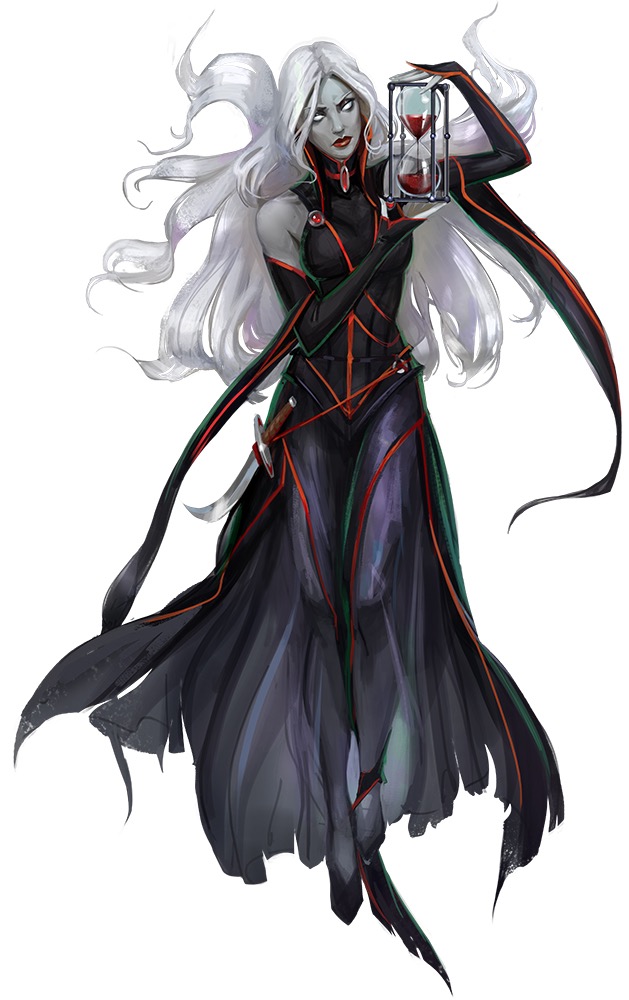
Pharasma (pronounced fah-RAZ-mah), the Lady of Graves, is the goddess of birth, death, fate, prophecy, and time. Gazing across all of time, she judges and shepherds Golarion's recently departed souls to their final fates. Upon death, souls migrate via the River of Souls to Pharasma's Boneyard for her judgment atop an impossibly tall spire in the Outer Sphere that pierces the Astral Plane.
- Alignment
-
N
NeutralA neutral character is unusual in that she may have one of two distinct philosophies: she may be a person who is neutral because of distrust or apathy toward others, or one who wishes to have a truly neutral stance in the world and rejects extremism.
A neutral character could seem selfish or disinterested. She might be driven primarily by an acceptance of fate, and the most extreme followers of this alignment become hermits, hiding from the zealots of the world. Some neutral characters, however, strive openly for neutrality, and shun any act that veers too extremely toward any alignment. This type of neutral character prides herself on navigating her way between law and chaos, evil and good. She may have a fatalistic view in the face of nature and the fundamental power of night and day. - Nationality
- Garundi
- Areas of Concern
- Birth, death, fate, prophecy
- Favored Weapon
- Dagger
- Symbol
- Spiraling comet
- Sacred Animals
- Whippoorwill
- Sacred Colors
- Blue, white
- Worshipers
- Midwives, pregnant women, morticians
- Worshipper Alignments
-
NG
Neutral GoodA neutral good character is good, but not shackled by order. He sees good where he can, but knows evil can exist even in the most ordered place., LN
A neutral good character does anything he can, and works with anyone he can, for the greater good. Such a character is devoted to being good, and works in any way he can to achieve it. He may forgive an evil person if he thinks that person has reformed, and he believes that in everyone there is a little bit of good.Lawful NeutralA lawful neutral character admires order and tradition, or seeks to live by a code. He might fear chaos and disorder, and perhaps have good reason to do so from past experience. A lawful neutral person is not as concerned about who rules him so much as how secure he and his compatriots are, and finds great solace in the normality of society. Such a character may admire the strongest of leaders and punishments if they keep order, and he may support wars against other nations even if his own country is a brutal invader—his only concern is the rightness of the military action., N
A lawful neutral character who follows his own code never breaks it willingly, and may become a martyr to defend it.NeutralA neutral character is unusual in that she may have one of two distinct philosophies: she may be a person who is neutral because of distrust or apathy toward others, or one who wishes to have a truly neutral stance in the world and rejects extremism., CN
A neutral character could seem selfish or disinterested. She might be driven primarily by an acceptance of fate, and the most extreme followers of this alignment become hermits, hiding from the zealots of the world. Some neutral characters, however, strive openly for neutrality, and shun any act that veers too extremely toward any alignment. This type of neutral character prides herself on navigating her way between law and chaos, evil and good. She may have a fatalistic view in the face of nature and the fundamental power of night and day.Chaotic NeutralA chaotic neutral character values his own freedom and ability to make choices. He avoids authority and does not fear standing out or appearing different. In extreme cases, he may embrace a lifestyle entirely suited to himself— living in a cave near a city, becoming an artist, or otherwise challenging traditions. He never accepts anything at face value and makes up his own mind rather than blindly accepting what others tell him to do or think., NENeutral EvilMotivated by his own needs and wants, a neutral evil character is without conscience, acting only for self-gratification. He might surround himself with the trappings of cults and evil, but does so purely because it brings him closer to sin and wickedness. While a lawful evil person is inclined to bargain and a chaotic evil one to lash out, a neutral evil person is inclined only to look out for himself. In many ways, he epitomizes evil, since he has no clear loyalty to anything except absolute self-interest.
An extremist neutral evil character tends to be a loner, since he has either betrayed or slain those who came close to knowing him. - Realms
- Pharasma's Palace, Boneyard
- Centers of Worship
- Brevoy, Nex, Osirion, The Shackles, Thuvia, Ustalav, Varisia
Edicts
Strive to understand ancient prophecies, destroy undead, lay bodies to rest
Anathema
Create undead, desecrate a corpse, take from the dead in bad faith
Obedience
Collect small bones whenever it is convenient and respectful to do so. When it comes time to perform your obedience, lay out the bones in a spiral. At one end of the spiral lay a slip of parchment on which you have written the name of someone newly born. At the other end of the spiral, lay a slip of parchment on which you have written the name of someone newly deceased. Chant hymns from The Bones Land in a Spiral while proceeding solemnly around the spiral, trailing a black scarf on the ground behind you. Gain a +2 profane or sacred bonus on attack rolls made with daggers. The type of bonus depends on your alignment—if you’re neither good nor evil, you must choose either sacred or profane the first time you perform your obedience, and this choice can’t be changed.Divine Gift
Divine Gifts
The gods do not need to wait for mortals to call upon them for aid to grant boons. At times, when a character performs a particularly devout act or completes a legendary crusade, that character’s deity may choose to reward her with a divine gift.
The timing and frequency in which divine gifts are granted is left strictly to the discretion of the GM. They can be given to a particularly devout worshiper in a time of need. They might be granted upon the completion of a significant quest that furthers the faith. Or they might be rewards given in return for a significant sacrifice made in a deity’s name or dedication shown to the deity. A divine gift can be granted to any creature, even to a follower of a different deity or to a creature who does not worship the divine at all. The only restriction is that a creature must be sapient in order to receive a divine gift, for a creature always has the option to refuse the gift if it so wishes—the freedom to accept or reject such a gift is part of the nature of this boon. However, at the GM’s discretion, rejecting a divine gift from a deity you worship (or accepting a divine gift from a rival deity) may have repercussions.
Divine gifts can be of any power level, but the example gifts presented in the following section focusing upon the core pantheon are all on par with effects that could be granted by a miracle spell—feel free to adjust this power level as you prefer for your home campaign. At your discretion, you can allow divine spellcasters to duplicate the effects of a divine gift (as appropriate for their deity) by casting miracle themselves.
Source: Planar Adventures
The recipient is not affected by the next effect, damage, or other event that would otherwise kill him.Boons
Deific Obedience
Required feat: Deific Obedience
Exalted
Source: Inner Sea Gods
PFS Legal
Preserver (Sp)
Decomposition (Su)
The Veil Is Drawn Aside (Su)
Evangelist
Source: Inner Sea Gods
PFS Legal
Quietude (Sp)
Strike the Unrestful (Su)
Ally from the Tomb (Sp)
Sentinel
Source: Inner Sea Gods
PFS Legal
Undead Slayer (Sp)
Disrupting Strike (Su)
Tethered to the Material (Ex)
Domains
Death, Healing, Knowledge, Repose, Water
Subdomains
Ancestors, Flowing, Ice, Memory, Psychopomp, Resurrection, Souls, Thought
Spells Requiring Worship
Unique Summon Rules
Source: Pathfinder #44: Trial of the Beast
- Summon Monster 3 : Nosoi PFS Legal
- Summon Monster 6 : Vanth PFS Legal
- Summon Monster 1 : Whippoorwill (uses eagle statistics) PFS Legal
- Summon Nature's Ally 1 : Whippoorwill (uses eagle statistics) PFS Legal
Unique Spell Rules
Source: Inner Sea Gods
PFS Legal
Bard, Inquisitor, Ranger, Sorcerer, Wizard — Augury : can be prepared as a 2nd-level spell
Bard, Ranger, Sorcerer, Wizard
- Death Knell : can be prepared as a 2nd-level spell
- Speak with Dead : can be prepared as a 3rd-level spell
Cleric, Inquisitor, Oracle, Warpriest
- False Life : can be prepared as a 2nd-level spell
- Clairaudience/Clairvoyance : can be prepared as a 3rd-level spell
Cleric, Oracle, Warpriest — Moment of Prescience : can be prepared as a 8th-level spell
Inquisitor — Moment of Prescience : can be prepared as a 6th-level spell
Other Rules
Since Pharasma despises undead, Pharasmin clerics with the Death domain replace the animate dead domain spell with speak with dead, replace create undead with antilife shell, and replace create greater undead with symbol of death. Clerics with the Souls subdomain (Advanced Player’s Guide 96) replace the animate dead domain spell with speak with dead.Source: Inner Sea Gods