Lamashtu
Mother of Monsters, The Demon Queen, Demon Mother, Mother of Beasts, Mother of Demons, Mother of Perversion, Mistress of Insanity, Grandmother Nightmare
PFS Legal
Pantheons
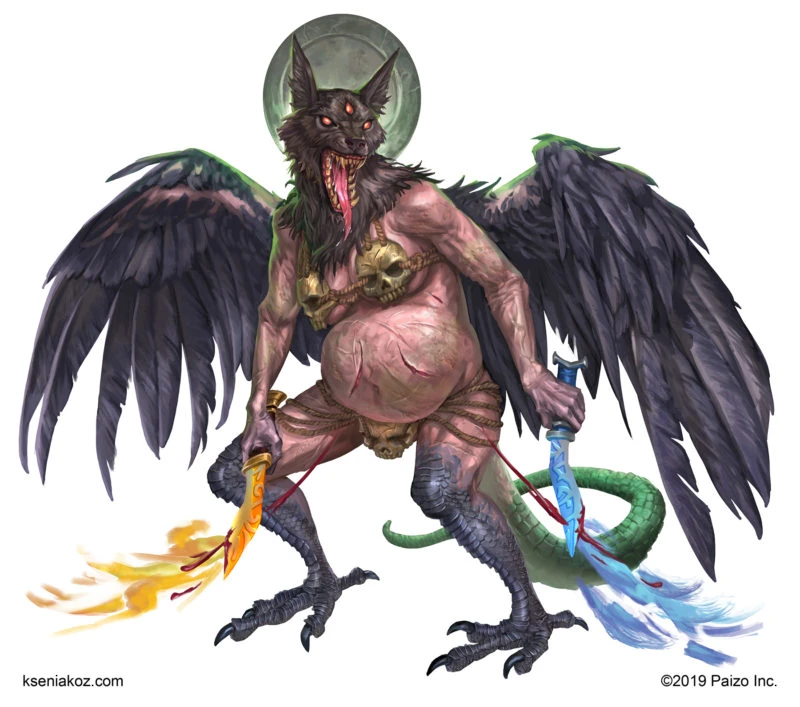
Lamashtu (pronounced lah-MAHSH-too) is the mother and patroness of many misshapen and malformed creatures that crawl, slither, or flap on, above, or below the surface of Golarion. Her religious symbol is a three-eyed jackal head, which may be represented in many ways, and her sacred animal is the jackal.
- Alignment
-
CE
Chaotic EvilA chaotic evil character is driven entirely by her own anger and needs. She is thoughtless in her actions and acts on whims, regardless of the suffering it causes others.
In many ways, a chaotic evil character is pinned down by her inherent nature to be unpredictable. She is like a spreading fire, a coming storm, an untested sword blade. An extreme chaotic evil character tends to find similarly minded individuals to be with—not out of any need for company, but because there is a familiarity in this chaos, and she relishes the opportunity to be true to her nature with others who share that delight. - Nationality
- Demon
- Areas of Concern
- Madness, monsters, nightmares
- Favored Weapon
- Falchion
- Symbol
- Three-eyed jackal
- Sacred Animals
- Jackal
- Sacred Colors
- Red, yellow
- Worshipers
- Kholo, medusas, harpies, goblins, minotaurs, hidden human cults, the insane, bugbears, deros, lamias, morlocks, ogres, monsters, outcasts
- Worshipper Alignments
-
CN
Chaotic NeutralA chaotic neutral character values his own freedom and ability to make choices. He avoids authority and does not fear standing out or appearing different. In extreme cases, he may embrace a lifestyle entirely suited to himself— living in a cave near a city, becoming an artist, or otherwise challenging traditions. He never accepts anything at face value and makes up his own mind rather than blindly accepting what others tell him to do or think., NENeutral EvilMotivated by his own needs and wants, a neutral evil character is without conscience, acting only for self-gratification. He might surround himself with the trappings of cults and evil, but does so purely because it brings him closer to sin and wickedness. While a lawful evil person is inclined to bargain and a chaotic evil one to lash out, a neutral evil person is inclined only to look out for himself. In many ways, he epitomizes evil, since he has no clear loyalty to anything except absolute self-interest., CE
An extremist neutral evil character tends to be a loner, since he has either betrayed or slain those who came close to knowing him.Chaotic EvilA chaotic evil character is driven entirely by her own anger and needs. She is thoughtless in her actions and acts on whims, regardless of the suffering it causes others.
In many ways, a chaotic evil character is pinned down by her inherent nature to be unpredictable. She is like a spreading fire, a coming storm, an untested sword blade. An extreme chaotic evil character tends to find similarly minded individuals to be with—not out of any need for company, but because there is a familiarity in this chaos, and she relishes the opportunity to be true to her nature with others who share that delight. - Realms
- Kurnugia, Outer Rifts
- Centers of Worship
- Belkzen, Irrisen, Katapesh, Nex, Osirion, River Kingdoms, Varisia, Worldwound
Edicts
Bring power to outcasts and the downtrodden, indoctrinate others in Lamashtu's teachings, make the beautiful monstrous, reveal the corruption and flaws in all things
Anathema
Attempt to change that which makes you different, provide succour to Lamashtu's enemies
Obedience
(Deific Obedience) Sacrifice an unwilling living creature in the name of the Mother of Monsters. Draw the process out to inspire the maximum terror and suffering in your victim. The death blow you deal should be savage and destructive—do not grant your sacrifice a clean death. Once the creature is dead, remove one of its bones and sharpen it to a point. Use the bone to cut yourself deeply enough to leave a scar. Leave the sacrificed creature’s mutilated form in the open where scavengers may devour it or travelers may see it and know of Lamashtu’s power. Gain a +1 natural armor bonus to your AC.(Demonic Obedience) Engage in a tryst with the sincere intention of being impregnated or impregnating your partner, or sacrifice a creature that has been alive for no more than a week. Gain a +4 profane bonus on saves against insanity, confusion, and polymorph effects.
Divine Gift
Divine Gifts
The gods do not need to wait for mortals to call upon them for aid to grant boons. At times, when a character performs a particularly devout act or completes a legendary crusade, that character’s deity may choose to reward her with a divine gift.
The timing and frequency in which divine gifts are granted is left strictly to the discretion of the GM. They can be given to a particularly devout worshiper in a time of need. They might be granted upon the completion of a significant quest that furthers the faith. Or they might be rewards given in return for a significant sacrifice made in a deity’s name or dedication shown to the deity. A divine gift can be granted to any creature, even to a follower of a different deity or to a creature who does not worship the divine at all. The only restriction is that a creature must be sapient in order to receive a divine gift, for a creature always has the option to refuse the gift if it so wishes—the freedom to accept or reject such a gift is part of the nature of this boon. However, at the GM’s discretion, rejecting a divine gift from a deity you worship (or accepting a divine gift from a rival deity) may have repercussions.
Divine gifts can be of any power level, but the example gifts presented in the following section focusing upon the core pantheon are all on par with effects that could be granted by a miracle spell—feel free to adjust this power level as you prefer for your home campaign. At your discretion, you can allow divine spellcasters to duplicate the effects of a divine gift (as appropriate for their deity) by casting miracle themselves.
Source: Planar Adventures
The recipient can disgorge a servitor monster from her body as a full-round action. The monster views the character as its mother and follows her general commands, although it can’t be directly controlled. The exact type of monster spawned is chosen by the GM, but is generally one whose CR is equal to the character’s level (or in the case of an NPC, the character’s own CR). The monster lives for 9 days, after which it dies in a spectacular shower of gore.Antipaladin Code
The leaders of Lamashtu’s children are proud of their deformities and rage against civilization. They seek to tear the blinders from the eyes of the world and show them the nightmare of nature, the writhing and endlessly fecund truth. Their code is one of bloodshed and howling madness. Its tenets include the following adages.- All things are monstrous, and only the weak hide their marks. I show the world as it is.
- I will bring the outcasts in from the cold and teach them the taste of victory.
- I fill the wombs. I birth the children. I teach our enemies why they fear the night.
- I bring madness to the cities, that in their blood and fear they may understand the chaos of the world.
- I will spread the Mother’s seed. If the blind cannot be taught to see, their children can.
Boons
Deific Obedience
Required feat: Deific Obedience
Evangelist
Source: Inner Sea Gods
Savage Summoner (Sp)
Terrifying Eidolon (Su)
Tainted Ally (Sp)
Exalted
Source: Inner Sea Gods
Howling Terror (Sp)
Maddening Thoughts (Su)
Monstrous Transformation (Sp)
Sentinel
Source: Inner Sea Gods
Ferocious Battler (Sp)
Bestial Jaws (Ex)
Scarred Form (Su)
Fiendish Obedience
Required feat: Fiendish Obedience
Evangelist
Source: Book of the Damned
Lunatic’s Gift (Sp)
Teratoma (Ex)
Third Eye (Su)
Exalted
Source: Book of the Damned
Howling Terror (Sp)
Maddening Thoughts (Su)
Monstrous Transformation (Sp)
Sentinel
Source: Book of the Damned
Ferocious Battler (Sp)
Bestial Jaws (Ex)
Scarred Form (Su)
Demonic Obedience
Required feat: Demonic Obedience
Demoniac
Source: Book of the Damned - Volume 2: Lords of Chaos
Lunatic’s Gift (Sp)
Teratoma (Ex)
Third Eye (Su)
Domains
Chaos, Evil, Madness, Strength, Trickery
Subdomains
Cannibalism, Corruption, Deception, Demon, Ferocity, Insanity, Nightmare, Riot, Thievery, Truth
Spells Requiring Worship
Unique Summon Rules
Source: Pathfinder #5: Sins of the Saviors
-
Summon Monster 3
:
Fiendish Worg
—CE
Chaotic EvilA chaotic evil character is driven entirely by her own anger and needs. She is thoughtless in her actions and acts on whims, regardless of the suffering it causes others.
In many ways, a chaotic evil character is pinned down by her inherent nature to be unpredictable. She is like a spreading fire, a coming storm, an untested sword blade. An extreme chaotic evil character tends to find similarly minded individuals to be with—not out of any need for company, but because there is a familiarity in this chaos, and she relishes the opportunity to be true to her nature with others who share that delight. -
Summon Monster 5
:
Barghest
—CE
Chaotic EvilA chaotic evil character is driven entirely by her own anger and needs. She is thoughtless in her actions and acts on whims, regardless of the suffering it causes others.(chaotic subtype instead of lawful)
In many ways, a chaotic evil character is pinned down by her inherent nature to be unpredictable. She is like a spreading fire, a coming storm, an untested sword blade. An extreme chaotic evil character tends to find similarly minded individuals to be with—not out of any need for company, but because there is a familiarity in this chaos, and she relishes the opportunity to be true to her nature with others who share that delight. -
Summon Monster 8
:
Warped One
—CE
Chaotic EvilA chaotic evil character is driven entirely by her own anger and needs. She is thoughtless in her actions and acts on whims, regardless of the suffering it causes others.
In many ways, a chaotic evil character is pinned down by her inherent nature to be unpredictable. She is like a spreading fire, a coming storm, an untested sword blade. An extreme chaotic evil character tends to find similarly minded individuals to be with—not out of any need for company, but because there is a familiarity in this chaos, and she relishes the opportunity to be true to her nature with others who share that delight. -
Summon Monster 8
:
Nightmare
—NE
Neutral EvilMotivated by his own needs and wants, a neutral evil character is without conscience, acting only for self-gratification. He might surround himself with the trappings of cults and evil, but does so purely because it brings him closer to sin and wickedness. While a lawful evil person is inclined to bargain and a chaotic evil one to lash out, a neutral evil person is inclined only to look out for himself. In many ways, he epitomizes evil, since he has no clear loyalty to anything except absolute self-interest.
An extremist neutral evil character tends to be a loner, since he has either betrayed or slain those who came close to knowing him.
Unique Spell Rules
Source: Inner Sea Gods
Cleric, Warpriest — Nightmare : can be prepared as a 6th-level spell
Cleric, Druid, Warpriest — Baleful Polymorph : can be prepared as a 5th-level spell
Other Rules
Druids/Rangers can use summon nature's ally spells to summon fiendish animals from the same level summon monster list.Source: Inner Sea Gods