Erastil
Old Deadeye, Stag God, Estig the Hunter, Elk Father
PFS Legal
Pantheons
Core Deities, Gnomish Deities, Halfling Deities, Sandpoint Pantheon
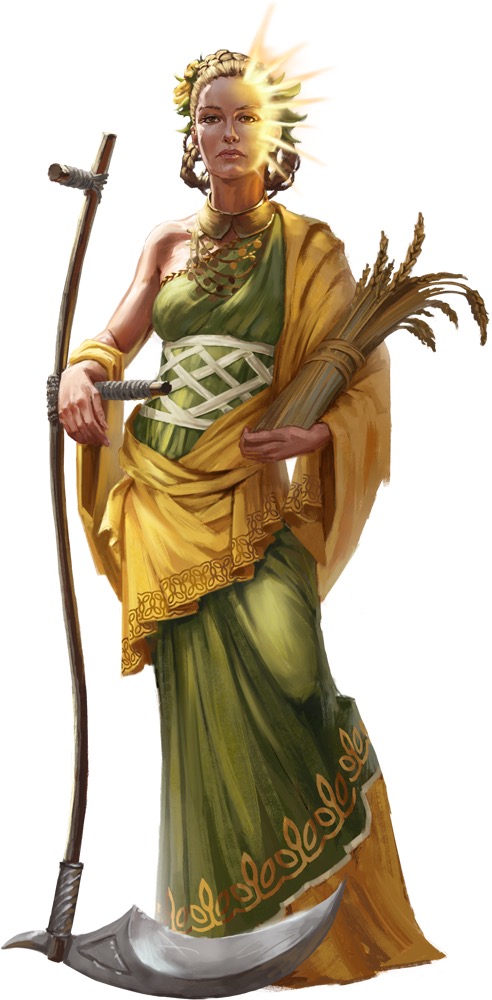
Erastil (pronounced eh-RAS-til) is one of the oldest human gods still worshiped in the Inner Sea region. His religion predates the Age of Darkness, when small farming communities and hunter-gatherers prayed to him for bountiful harvests and successful hunts. He leads his followers by example and good deeds rather than flowery rhetoric.
- Alignment
-
LG
Lawful GoodA lawful good character believes in honor. A code or faith that she has unshakable belief in likely guides her. She would rather die than betray that faith, and the most extreme followers of this alignment are willing (sometimes even happy) to become martyrs.
A lawful good character at the extreme end of the lawful-chaotic spectrum can seem pitiless. She may become obsessive about delivering justice, thinking nothing of dedicating herself to chasing a wicked dragon across the world or pursuing a devil into Hell. She can come across as a taskmaster, bent upon her aims without swerving, and may see others who are less committed as weak. Though she may seem austere, even harsh, she is always consistent, working from her doctrine or faith. Hers is a world of order, and she obeys superiors and finds it almost impossible to believe there’s any bad in them. She may be more easily duped by such imposters, but in the end she will see justice is done—by her own hand if necessary. - Nationality
- Ulfen
- Areas of Concern
- Family, farming, hunting, trade
- Favored Weapon
- Longbow
- Symbol
- Bow and arrow
- Sacred Animals
- Stag
- Sacred Colors
- Brown, green
- Worshipers
- Farmers, hunters, tradesmen
- Worshipper Alignments
-
LG
Lawful GoodA lawful good character believes in honor. A code or faith that she has unshakable belief in likely guides her. She would rather die than betray that faith, and the most extreme followers of this alignment are willing (sometimes even happy) to become martyrs., NG
A lawful good character at the extreme end of the lawful-chaotic spectrum can seem pitiless. She may become obsessive about delivering justice, thinking nothing of dedicating herself to chasing a wicked dragon across the world or pursuing a devil into Hell. She can come across as a taskmaster, bent upon her aims without swerving, and may see others who are less committed as weak. Though she may seem austere, even harsh, she is always consistent, working from her doctrine or faith. Hers is a world of order, and she obeys superiors and finds it almost impossible to believe there’s any bad in them. She may be more easily duped by such imposters, but in the end she will see justice is done—by her own hand if necessary.Neutral GoodA neutral good character is good, but not shackled by order. He sees good where he can, but knows evil can exist even in the most ordered place., LN
A neutral good character does anything he can, and works with anyone he can, for the greater good. Such a character is devoted to being good, and works in any way he can to achieve it. He may forgive an evil person if he thinks that person has reformed, and he believes that in everyone there is a little bit of good.Lawful NeutralA lawful neutral character admires order and tradition, or seeks to live by a code. He might fear chaos and disorder, and perhaps have good reason to do so from past experience. A lawful neutral person is not as concerned about who rules him so much as how secure he and his compatriots are, and finds great solace in the normality of society. Such a character may admire the strongest of leaders and punishments if they keep order, and he may support wars against other nations even if his own country is a brutal invader—his only concern is the rightness of the military action.
A lawful neutral character who follows his own code never breaks it willingly, and may become a martyr to defend it. - Realms
- Summerlands, Requius, Heaven
- Centers of Worship
- Andoran, Cheliax, Galt, Isger, Lands of the Linnorm Kings, Mana Wastes, Molthune, Nirmathas, River Kingdoms, Varisia
Edicts
Care for your home and family, fulfill your duties, keep the peace, protect the community
Anathema
Abandon your home in time of need, choose yourself over your community, tarnish your reputation, tell lies
Obedience
Plant five seeds in fertile earth, spacing them out in the shape of an arrow. The seeds may be those of any plant that can potentially grow in the region, though edible plants are preferred. The seeds don’t need to be from a type of plant that could thrive in that soil—all they must have is a chance at survival. If no suitable earth exists, place a small bundle of seeds (again, those that grow edible plants are preferred), a small bundle of preserved food, or a quiver of arrows in a place where a passerby might see it. Mark your gifts with Erastil’s sign, and say a prayer for the health and safety of the communities in the area and those who may be in need of Erastil’s guidance. Gain a +4 sacred bonus on Survival checks.Divine Gift
Divine Gifts
The gods do not need to wait for mortals to call upon them for aid to grant boons. At times, when a character performs a particularly devout act or completes a legendary crusade, that character’s deity may choose to reward her with a divine gift.
The timing and frequency in which divine gifts are granted is left strictly to the discretion of the GM. They can be given to a particularly devout worshiper in a time of need. They might be granted upon the completion of a significant quest that furthers the faith. Or they might be rewards given in return for a significant sacrifice made in a deity’s name or dedication shown to the deity. A divine gift can be granted to any creature, even to a follower of a different deity or to a creature who does not worship the divine at all. The only restriction is that a creature must be sapient in order to receive a divine gift, for a creature always has the option to refuse the gift if it so wishes—the freedom to accept or reject such a gift is part of the nature of this boon. However, at the GM’s discretion, rejecting a divine gift from a deity you worship (or accepting a divine gift from a rival deity) may have repercussions.
Divine gifts can be of any power level, but the example gifts presented in the following section focusing upon the core pantheon are all on par with effects that could be granted by a miracle spell—feel free to adjust this power level as you prefer for your home campaign. At your discretion, you can allow divine spellcasters to duplicate the effects of a divine gift (as appropriate for their deity) by casting miracle themselves.
Source: Planar Adventures
The character gains three greater slaying arrows. The designated creatures for each of these three arrows is determined by the GM. The magic of these greater slaying arrows vanishes if they are sold, but they can be given to others in trade for goods or as a gift. If a worshiper of Erastil fires one of these greater slaying arrows and misses, the arrow vanishes and a slaying arrow of the same type appears in the gifted character’s quiver. If this regular slaying arrow is then fired, only to miss its target, it has a 50% chance to be lost, as normal.Paladin Code
The paladins of Erastil are gruff, strict traditionalists. They seek to preserve the integrity of rural life and communities. Their tenets include the following affirmations.- My community comes first, and I will contribute to it all that I can. If I don’t give something back, who will?
- I must offer the poor in my community assistance, but I may not do the work for them—instead, I must teach them to contribute to the settlement. It is only through cooperation that a community grows strong.
- When danger threatens, I am not a fool. I seek first to make sure the weak and innocent are safe, and then I quell the danger.
- I keep to the old ways, the true ways. I am not seduced by the lure of money or power. I remember that true honor comes from within, not from the accolades of others.
- I remember that reputation is everything. Mine is pure and upstanding, and I will repair it if it is broken or tarnished. I stand by my decisions, and live so that none shall have cause to blame me.
- I show respect to my elders, for they have done much. I show respect to the young, for they have much left to do. I show respect to my peers, for they carry the load. And I shall carry it with them.
- I am honest, trustworthy, and stable. If I must leave my lands and community, before I go, I ensure that they will be tended in my absence. Even when duty calls, my duties to my home come first—letting them lapse makes me a burden on my people.
Boons
Deific Obedience
Required feat: Deific Obedience
Evangelist
Source: Inner Sea Gods
PFS Legal
Family's Bond (Sp)
Twin Fang (Ex)
Faithful Archer (Ex)
Exalted
Source: Inner Sea Gods
PFS Legal
Animal Friend (Sp)
Hunter's Ally (Sp)
Communal Table (Sp)
Sentinel
Source: Inner Sea Gods
PFS Legal
Sureshot (Sp)
Tough Hide (Su)
Farmer's Bond (Su)
Domains
Animal, Community, Good, Law, Plant
Subdomains
Spells Requiring Worship
Unique Summon Rules
Source: Pathfinder #32: Rivers Run Red
-
Summon Monster 2
:
Celestial Elk
—LG
Lawful GoodA lawful good character believes in honor. A code or faith that she has unshakable belief in likely guides her. She would rather die than betray that faith, and the most extreme followers of this alignment are willing (sometimes even happy) to become martyrs.PFS Legal
A lawful good character at the extreme end of the lawful-chaotic spectrum can seem pitiless. She may become obsessive about delivering justice, thinking nothing of dedicating herself to chasing a wicked dragon across the world or pursuing a devil into Hell. She can come across as a taskmaster, bent upon her aims without swerving, and may see others who are less committed as weak. Though she may seem austere, even harsh, she is always consistent, working from her doctrine or faith. Hers is a world of order, and she obeys superiors and finds it almost impossible to believe there’s any bad in them. She may be more easily duped by such imposters, but in the end she will see justice is done—by her own hand if necessary. -
Summon Monster 3
:
Celestial Dire Boar
—LG
Lawful GoodA lawful good character believes in honor. A code or faith that she has unshakable belief in likely guides her. She would rather die than betray that faith, and the most extreme followers of this alignment are willing (sometimes even happy) to become martyrs.PFS Legal
A lawful good character at the extreme end of the lawful-chaotic spectrum can seem pitiless. She may become obsessive about delivering justice, thinking nothing of dedicating herself to chasing a wicked dragon across the world or pursuing a devil into Hell. She can come across as a taskmaster, bent upon her aims without swerving, and may see others who are less committed as weak. Though she may seem austere, even harsh, she is always consistent, working from her doctrine or faith. Hers is a world of order, and she obeys superiors and finds it almost impossible to believe there’s any bad in them. She may be more easily duped by such imposters, but in the end she will see justice is done—by her own hand if necessary.
Unique Spell Rules
Source: Inner Sea Gods
PFS Legal
Cleric, Paladin, Ranger, Warpriest — Goodberry : can be prepared as a 2nd-level spell
Cleric, Paladin, Warpriest — Animal Messenger : can be prepared as a 2nd-level spell [may use on any nonhostile animal (including friendly guard animals and domesticated animals)]
Druid — Goodberry : can be prepared as a 1st-level spell [can cast on nuts or seeds as well as berries]
Other Rules
Source: Gods and Magic