Urgathoa
The Pallid Princess, Lady Despair
PFS Legal
Pantheon
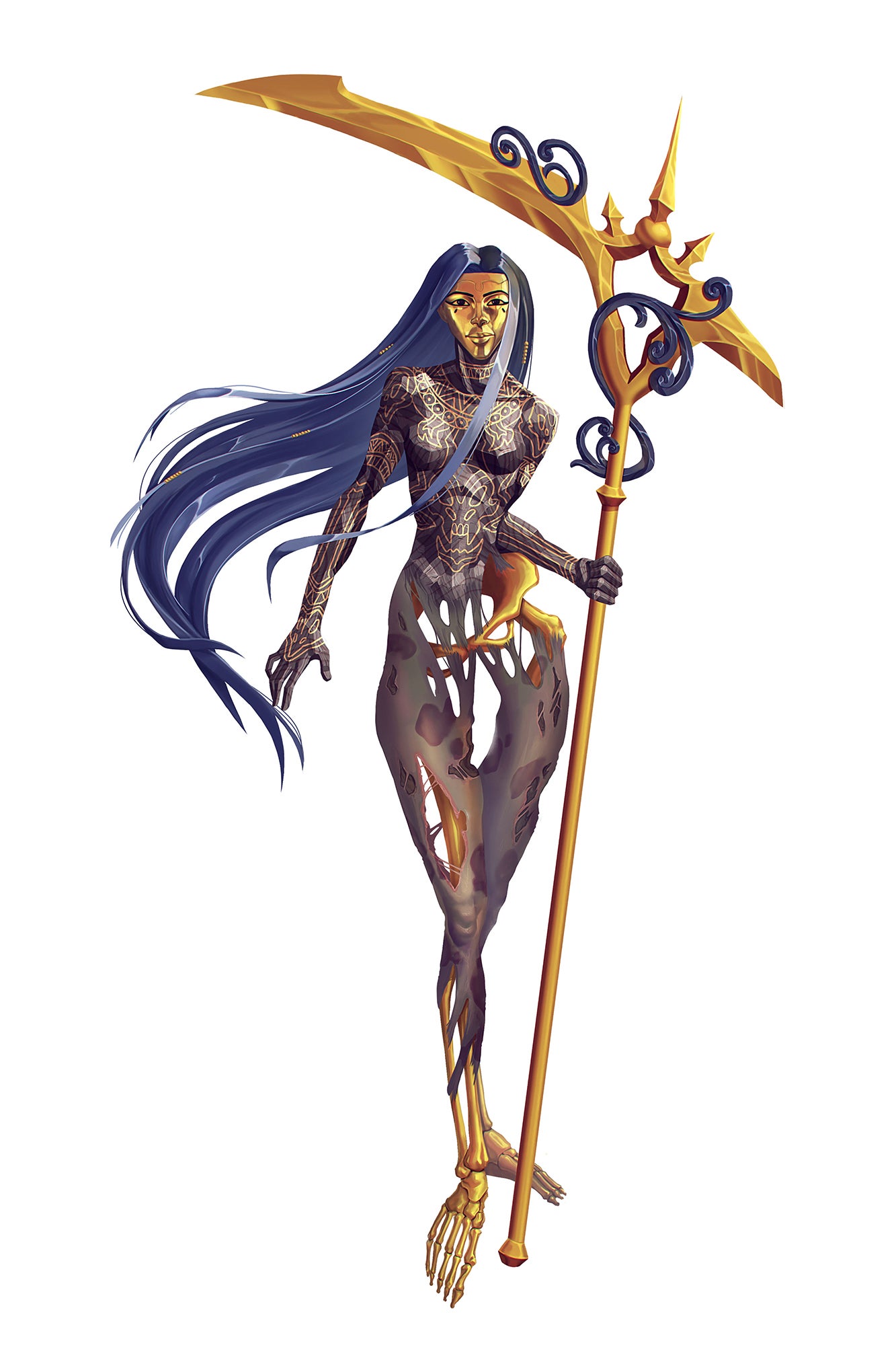
Urgathoa (pronounced oor-gah-THO-ah) is the Varisian goddess of physical excess, disease, and the undead. She is mostly worshipped by hedonists, dark necromancers, the undead, and those wishing to become undead. Sometimes those who live gluttonous lifestyles make supplication to her, as do those suffering from a serious illness.
- Alignment
-
NE
Neutral EvilMotivated by his own needs and wants, a neutral evil character is without conscience, acting only for self-gratification. He might surround himself with the trappings of cults and evil, but does so purely because it brings him closer to sin and wickedness. While a lawful evil person is inclined to bargain and a chaotic evil one to lash out, a neutral evil person is inclined only to look out for himself. In many ways, he epitomizes evil, since he has no clear loyalty to anything except absolute self-interest.
An extremist neutral evil character tends to be a loner, since he has either betrayed or slain those who came close to knowing him. - Nationality
- Varisian
- Areas of Concern
- Disease, gluttony, undeath
- Favored Weapon
- Scythe
- Symbol
- Skull-decorated fly
- Sacred Animals
- Fly
- Sacred Colors
- Red, green
- Worshipper Alignments
-
N
NeutralA neutral character is unusual in that she may have one of two distinct philosophies: she may be a person who is neutral because of distrust or apathy toward others, or one who wishes to have a truly neutral stance in the world and rejects extremism., LE
A neutral character could seem selfish or disinterested. She might be driven primarily by an acceptance of fate, and the most extreme followers of this alignment become hermits, hiding from the zealots of the world. Some neutral characters, however, strive openly for neutrality, and shun any act that veers too extremely toward any alignment. This type of neutral character prides herself on navigating her way between law and chaos, evil and good. She may have a fatalistic view in the face of nature and the fundamental power of night and day.Lawful EvilA lawful evil character goes about her business motivated by her own interests, but knows that ultimately order protects her. She seeks to achieve her own ends—but through order, not chaos. Even when boiling with anger, she is more likely to carefully plot vengeance than risk her own death through hasty actions. Sometimes that revenge will take years to happen, and that is acceptable., NE
A lawful evil character at the extreme end of the spectrum is zealous in her aims and will make any sacrifice to achieve them. Her twisted philosophy can make her paranoid of her closest followers, even family and friends. She stops at nothing to gain control, for only through control can she have peace. Yet even the most powerful and ordered society has its enemies, and to a lawful evil character only the destruction of those enemies can bring fulfillment.
Order is everything, at any cost.Neutral EvilMotivated by his own needs and wants, a neutral evil character is without conscience, acting only for self-gratification. He might surround himself with the trappings of cults and evil, but does so purely because it brings him closer to sin and wickedness. While a lawful evil person is inclined to bargain and a chaotic evil one to lash out, a neutral evil person is inclined only to look out for himself. In many ways, he epitomizes evil, since he has no clear loyalty to anything except absolute self-interest., CE
An extremist neutral evil character tends to be a loner, since he has either betrayed or slain those who came close to knowing him.Chaotic EvilA chaotic evil character is driven entirely by her own anger and needs. She is thoughtless in her actions and acts on whims, regardless of the suffering it causes others.
In many ways, a chaotic evil character is pinned down by her inherent nature to be unpredictable. She is like a spreading fire, a coming storm, an untested sword blade. An extreme chaotic evil character tends to find similarly minded individuals to be with—not out of any need for company, but because there is a familiarity in this chaos, and she relishes the opportunity to be true to her nature with others who share that delight. - Realms
- Bloodrot, Abaddon
- Centers of Worship
- Darklands, Geb, Osirion, Ustalav, Varisia
Edicts
Become undead upon death, create or protect the undead, sate your appetites
Anathema
Deny your appetites, destroy undead of no harm to you, sacrifice your life
Obedience
Cover a table (or suitable flat surface) with a black velvet cloth and spread a feast atop it. If you are in the wilderness or another area where fine food is not readily available, load the table with the best quality food you can find in whatever amount you have. Eat to the point of painful fullness, sipping wine between dishes and reciting a prayer to Urgathoa. At the end of the hour, consume a piece of rotten fruit, rancid meat, moldy cheese, or other spoiled bit of food. Trust in Urgathoa to protect you from any sickness or disease that might follow. Treat your caster level as 1 higher when casting necromancy spells.Divine Gift
Divine Gifts
The gods do not need to wait for mortals to call upon them for aid to grant boons. At times, when a character performs a particularly devout act or completes a legendary crusade, that character’s deity may choose to reward her with a divine gift.
The timing and frequency in which divine gifts are granted is left strictly to the discretion of the GM. They can be given to a particularly devout worshiper in a time of need. They might be granted upon the completion of a significant quest that furthers the faith. Or they might be rewards given in return for a significant sacrifice made in a deity’s name or dedication shown to the deity. A divine gift can be granted to any creature, even to a follower of a different deity or to a creature who does not worship the divine at all. The only restriction is that a creature must be sapient in order to receive a divine gift, for a creature always has the option to refuse the gift if it so wishes—the freedom to accept or reject such a gift is part of the nature of this boon. However, at the GM’s discretion, rejecting a divine gift from a deity you worship (or accepting a divine gift from a rival deity) may have repercussions.
Divine gifts can be of any power level, but the example gifts presented in the following section focusing upon the core pantheon are all on par with effects that could be granted by a miracle spell—feel free to adjust this power level as you prefer for your home campaign. At your discretion, you can allow divine spellcasters to duplicate the effects of a divine gift (as appropriate for their deity) by casting miracle themselves.
Source: Planar Adventures
The recipient dies and rises at the next sunset (or after 12 hours have passed, whichever comes first, but never in a situation that would result in the gift being granted during the day) as a vampire. (At the GM’s discretion, other vampire templates, such as jiang-shi or nosferatu, can be applied rather than the standard vampire template.) If the character is already a vampire, he does not suffer any of the traditional vampire weaknesses (such as sunlight or running water) for 24 hours.Antipaladin Code
The antipaladins of Urgathoa are creatures of the night, plague-bearers and bringers of death. They seek to spread Urgathoa’s gifts by the sword and by emulating their goddess. Their tenets include the following affirmations.- The grave opens to us all. We hasten the living on their inevitable path.
- The deathless are the true expression of existence, for they are beyond life and death. I will emulate their ways and destroy those who would defile their timeless perfection.
- I have no duty but to my hunger and my goddess.
- Existence is hunger. Both life and death feed on life. I am an instrument of transition.
Boons
Deific Obedience
Required feat: Deific Obedience
Evangelist
Source: Inner Sea Gods
PFS Legal
Pestilent Penitent (Sp)
Death Knowledge (Su)
Blight of Ruin (Su)
Exalted
Source: Inner Sea Gods
PFS Legal
Mistress of Undeath (Sp)
Bolstering Channel (Su)
Ally from the Grave (Sp)
Sentinel
Source: Inner Sea Gods
PFS Legal
Glutton for Slaughter (Sp)
Scythe Wielder (Ex)
Fearless in the Face of Undeath (Ex)
Domains
Death, Evil, Magic, Strength, War
Subdomains
Blood, Cannibalism, Corruption, Daemon, Divine, Ferocity, Murder, Plague, Self-Realization, Shadow, Undead
Spells Requiring Worship
Unique Summon Rules
Source: Pathfinder #47: Ashes at Dawn
- Summon Monster 1 : Bloody Human Skeleton PFS Legal
- Summon Monster 7 : Daughter of Urgathoa (extraplanar) PFS Legal
Unique Spell Rules
Source: Inner Sea Gods
PFS Legal
Antipaladin, Cleric, Inquisitor, Warpriest — Ghoul Touch : can be prepared as a 2nd-level spell
Antipaladin — Purify Food and Drink : can be prepared as a 1st-level spell
Inquisitor — Purify Food and Drink : can be prepared as a 0-level spell
Sorcerer
- Contagion : can be prepared as a 3rd-level spell [arcane version]
- Remove Disease : can be prepared as a 3rd-level spell [arcane version]
Wizard
- Contagion : can be prepared as a 3rd-level spell [necromancer only, arcane version]
- Remove Disease : can be prepared as a 3rd-level spell [necromancer only, arcane version]
Other Rules
Priests who cast remove disease may draw diseases into themselves as they heal their targets; they become carriers without suffering ill effects. Contagion spells cast by Urgathoa’s priests always use the caster’s spell DC for the disease’s secondary saves.Source: Inner Sea Gods