Iomedae
The Inheritor, Light of the Sword, Lady of Valor
PFS Legal
Pantheons
Ascended Pantheon, Core Deities, Halfling Deities, Order of the God Claw Pantheon
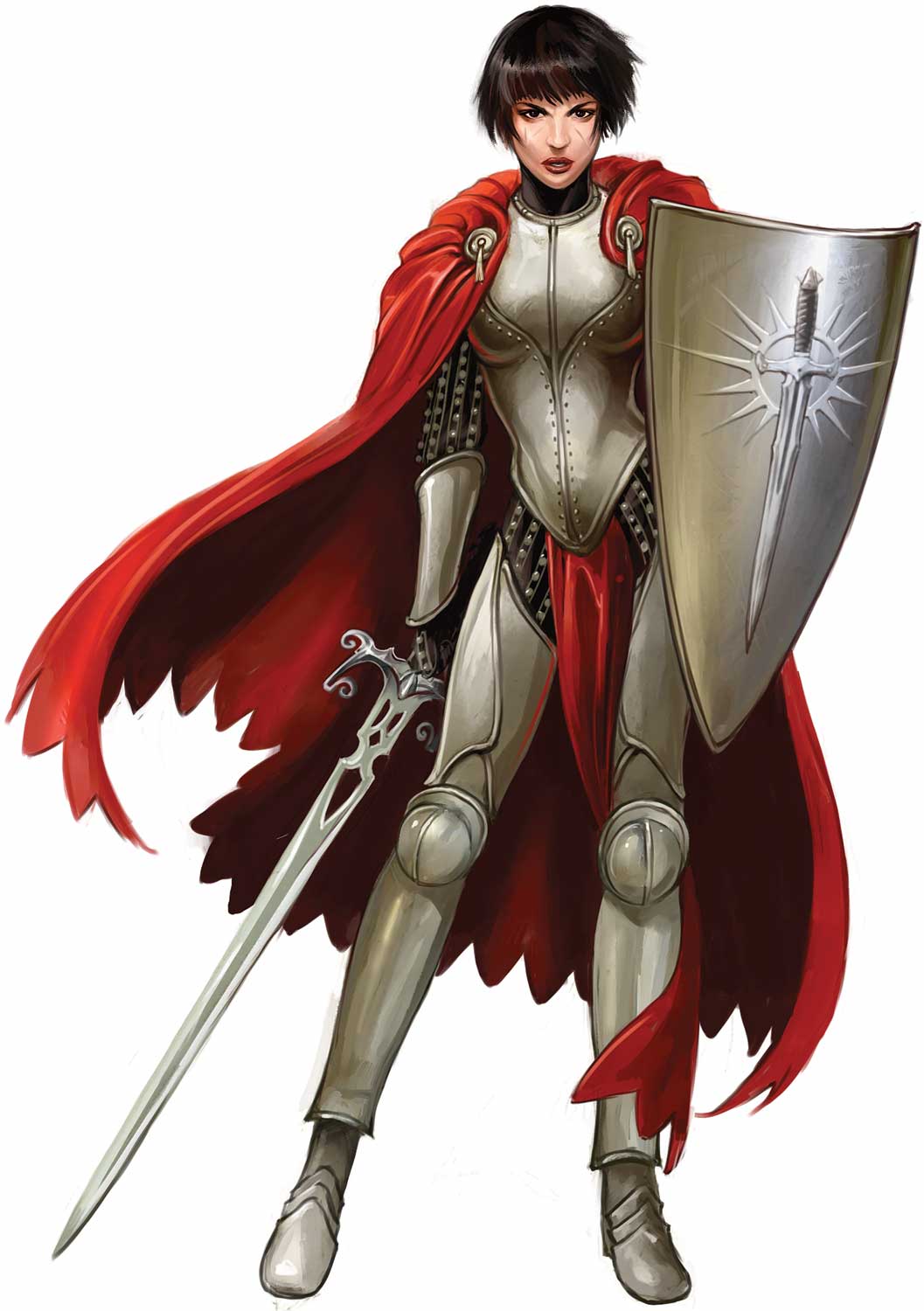
Iomedae (pronounced ahy-OH-meh-day) is the goddess of righteous valor, justice, and honor. Having served as Aroden's herald, she inherited many of the Last Azlanti's followers upon his death, and continues to espouse the ideas of honor and righteousness in the defense of good and the battle against evil.
- Alignment
-
LG
Lawful GoodA lawful good character believes in honor. A code or faith that she has unshakable belief in likely guides her. She would rather die than betray that faith, and the most extreme followers of this alignment are willing (sometimes even happy) to become martyrs.
A lawful good character at the extreme end of the lawful-chaotic spectrum can seem pitiless. She may become obsessive about delivering justice, thinking nothing of dedicating herself to chasing a wicked dragon across the world or pursuing a devil into Hell. She can come across as a taskmaster, bent upon her aims without swerving, and may see others who are less committed as weak. Though she may seem austere, even harsh, she is always consistent, working from her doctrine or faith. Hers is a world of order, and she obeys superiors and finds it almost impossible to believe there’s any bad in them. She may be more easily duped by such imposters, but in the end she will see justice is done—by her own hand if necessary. - Nationality
- Chelaxian
- Areas of Concern
- Honor, justice, rulership, valor
- Favored Weapon
- Longsword
- Symbol
- Sword and sun
- Sacred Animals
- Lion
- Sacred Colors
- Red, white
- Worshipers
- Paladins, knights, warriors
- Worshipper Alignments
-
LG
Lawful GoodA lawful good character believes in honor. A code or faith that she has unshakable belief in likely guides her. She would rather die than betray that faith, and the most extreme followers of this alignment are willing (sometimes even happy) to become martyrs., NG
A lawful good character at the extreme end of the lawful-chaotic spectrum can seem pitiless. She may become obsessive about delivering justice, thinking nothing of dedicating herself to chasing a wicked dragon across the world or pursuing a devil into Hell. She can come across as a taskmaster, bent upon her aims without swerving, and may see others who are less committed as weak. Though she may seem austere, even harsh, she is always consistent, working from her doctrine or faith. Hers is a world of order, and she obeys superiors and finds it almost impossible to believe there’s any bad in them. She may be more easily duped by such imposters, but in the end she will see justice is done—by her own hand if necessary.Neutral GoodA neutral good character is good, but not shackled by order. He sees good where he can, but knows evil can exist even in the most ordered place., LN
A neutral good character does anything he can, and works with anyone he can, for the greater good. Such a character is devoted to being good, and works in any way he can to achieve it. He may forgive an evil person if he thinks that person has reformed, and he believes that in everyone there is a little bit of good.Lawful NeutralA lawful neutral character admires order and tradition, or seeks to live by a code. He might fear chaos and disorder, and perhaps have good reason to do so from past experience. A lawful neutral person is not as concerned about who rules him so much as how secure he and his compatriots are, and finds great solace in the normality of society. Such a character may admire the strongest of leaders and punishments if they keep order, and he may support wars against other nations even if his own country is a brutal invader—his only concern is the rightness of the military action.
A lawful neutral character who follows his own code never breaks it willingly, and may become a martyr to defend it. - Realms
- Iomedae's Realm, Heaven
- Centers of Worship
- Absalom, Andoran, Cheliax, Galt, Lastwall, Mendev, Molthune, Nirmathas, Sargava
Edicts
Be temperate, fight for justice and honor, hold valor in your heart
Anathema
Abandon a companion in need, dishonor yourself, refuse a challenge from an equal
Obedience
Hold your primary weapon in front of you and hang a holy symbol of Iomedae from it. Kneel while focusing on the holy symbol, pray for guidance and protection from the Inheritor, and swear to follow her teachings. Gain a +4 sacred bonus on Diplomacy and Knowledge (nobility) checks.Divine Gift
Divine Gifts
The gods do not need to wait for mortals to call upon them for aid to grant boons. At times, when a character performs a particularly devout act or completes a legendary crusade, that character’s deity may choose to reward her with a divine gift.
The timing and frequency in which divine gifts are granted is left strictly to the discretion of the GM. They can be given to a particularly devout worshiper in a time of need. They might be granted upon the completion of a significant quest that furthers the faith. Or they might be rewards given in return for a significant sacrifice made in a deity’s name or dedication shown to the deity. A divine gift can be granted to any creature, even to a follower of a different deity or to a creature who does not worship the divine at all. The only restriction is that a creature must be sapient in order to receive a divine gift, for a creature always has the option to refuse the gift if it so wishes—the freedom to accept or reject such a gift is part of the nature of this boon. However, at the GM’s discretion, rejecting a divine gift from a deity you worship (or accepting a divine gift from a rival deity) may have repercussions.
Divine gifts can be of any power level, but the example gifts presented in the following section focusing upon the core pantheon are all on par with effects that could be granted by a miracle spell—feel free to adjust this power level as you prefer for your home campaign. At your discretion, you can allow divine spellcasters to duplicate the effects of a divine gift (as appropriate for their deity) by casting miracle themselves.
Source: Planar Adventures
By spending 10 minutes in prayer to Iomedae (this may take place during daily preparation of spells), a character can activate a holy aura or shield of law effect on himself (CL 20th) that lasts for the next 12 hours.Paladin Code
The paladins of Iomedae are just and strong, crusaders who live for the joy of righteous battle. Their mission is to right wrongs and eliminate evil at its root. They serve as examples to others, and their code demands they protect the weak and innocent by eliminating sources of oppression, rather than merely the symptoms. They may back down or withdraw from a fight if they are overmatched, but if their lives will buy time for others to escape, they must give them. Their tenets include the following affirmations.- I will learn the weight of my sword. Without my heart to guide it, it is worthless—my strength is not in my sword, but in my heart. If I lose my sword, I have lost a tool. If I betray my heart, I have died.
- I will have faith in the Inheritor. I will channel her strength through my body. I will shine in her legion, and I will not tarnish her glory through base actions.
- I am the first into battle, and the last to leave it.
- I will not be taken prisoner by my free will. I will not surrender those under my command.
- I will never abandon a companion, though I will honor sacrifice freely given.
- I will guard the honor of my fellows, both in thought and deed, and I will have faith in them.
- When in doubt, I may force my enemies to surrender, but I am responsible for their lives.
- I will never refuse a challenge from an equal. I will give honor to worthy enemies, and contempt to the rest.
- I will suffer death before dishonor.
- I will be temperate in my actions and moderate in my behavior. I will strive to emulate Iomedae’s perfection.
Boons
Deific Obedience
Required feat: Deific Obedience
Evangelist
Source: Inner Sea Gods
PFS Legal
Courageous (Sp)
Demon-Feared Caster (Ex)
Wrath of the Inheritor (Su)
Exalted
Source: Inner Sea Gods
PFS Legal
Glorious Servant (Sp)
Righteous Strike (Sp)
Just Ally (Sp)
Sentinel
Source: Inner Sea Gods
PFS Legal
Knight of Valor (Sp)
Valorous Smite (Su)
If you don’t have the smite evil class feature, instead you can, as a free action, single out an outsider with the evil subtype or an evil-aligned dragon you plan to vanquish. Against this target, you gain a +2 sacred bonus on attack rolls and a sacred bonus equal to your sentinel level on damage rolls. The bonuses remain until the target is dead or you use this ability again, whichever comes first. If you choose a target that is not one of the listed creature types, the ability is wasted. You can use this ability a number of times per day equal to your Charisma bonus (minimum once per day).
Banishing Strike (Sp)
Domains
Subdomains
Archon, Chivalry, Day, Duels, Heroism, Honor, Hubris, Light, Redemption, Revelation, Sovereignty, Tactics
Spells Requiring Worship
Burst of Glory, Inheritor's Smite, Light Prison, Weapons Against Evil
Unique Summon Rules
Source: Pathfinder #26: The Sixfold Trial
-
Summon Monster 4
:
Celestial Lion
—LG
Lawful GoodA lawful good character believes in honor. A code or faith that she has unshakable belief in likely guides her. She would rather die than betray that faith, and the most extreme followers of this alignment are willing (sometimes even happy) to become martyrs.PFS Legal
A lawful good character at the extreme end of the lawful-chaotic spectrum can seem pitiless. She may become obsessive about delivering justice, thinking nothing of dedicating herself to chasing a wicked dragon across the world or pursuing a devil into Hell. She can come across as a taskmaster, bent upon her aims without swerving, and may see others who are less committed as weak. Though she may seem austere, even harsh, she is always consistent, working from her doctrine or faith. Hers is a world of order, and she obeys superiors and finds it almost impossible to believe there’s any bad in them. She may be more easily duped by such imposters, but in the end she will see justice is done—by her own hand if necessary. -
Summon Monster 6
:
Celestial Griffon
—NG
Neutral GoodA neutral good character is good, but not shackled by order. He sees good where he can, but knows evil can exist even in the most ordered place.PFS Legal
A neutral good character does anything he can, and works with anyone he can, for the greater good. Such a character is devoted to being good, and works in any way he can to achieve it. He may forgive an evil person if he thinks that person has reformed, and he believes that in everyone there is a little bit of good. -
Summon Nature's Ally 6
:
Celestial Griffon
—NG
Neutral GoodA neutral good character is good, but not shackled by order. He sees good where he can, but knows evil can exist even in the most ordered place.PFS Legal
A neutral good character does anything he can, and works with anyone he can, for the greater good. Such a character is devoted to being good, and works in any way he can to achieve it. He may forgive an evil person if he thinks that person has reformed, and he believes that in everyone there is a little bit of good.
Unique Spell Rules
Source: Inner Sea Gods
PFS Legal
Cleric, Warpriest
- Holy Sword : can be prepared as a 8th-level spell
- Good Hope : can be prepared as a 4th-level spell
- Mark of Justice : can be prepared as a 4th-level spell
Inquisitor — Holy Sword : can be prepared as a 6th-level spell
Paladin
- Good Hope : can be prepared as a 3rd-level spell
- Mark of Justice : can be prepared as a 3rd-level spell